On the Limit of Empathy
When you witness pain, a small population of cells in your brain activates — the same cells that would activate if the pain were yours. The brain, at that level of resolution, does not distinguish between self and other. You are, briefly, the person hurting.
But only briefly, and only partially. The signal bridges the biological gap, but it arrives changed, filtered through every experience that makes you you and not them. What you feel is real. But it is also not quite theirs. The gap between those two things is small enough to feel like nothing and large enough to matter enormously, especially when the person hurting is someone you love.
That gap is what this painting titled Remainder is all about.
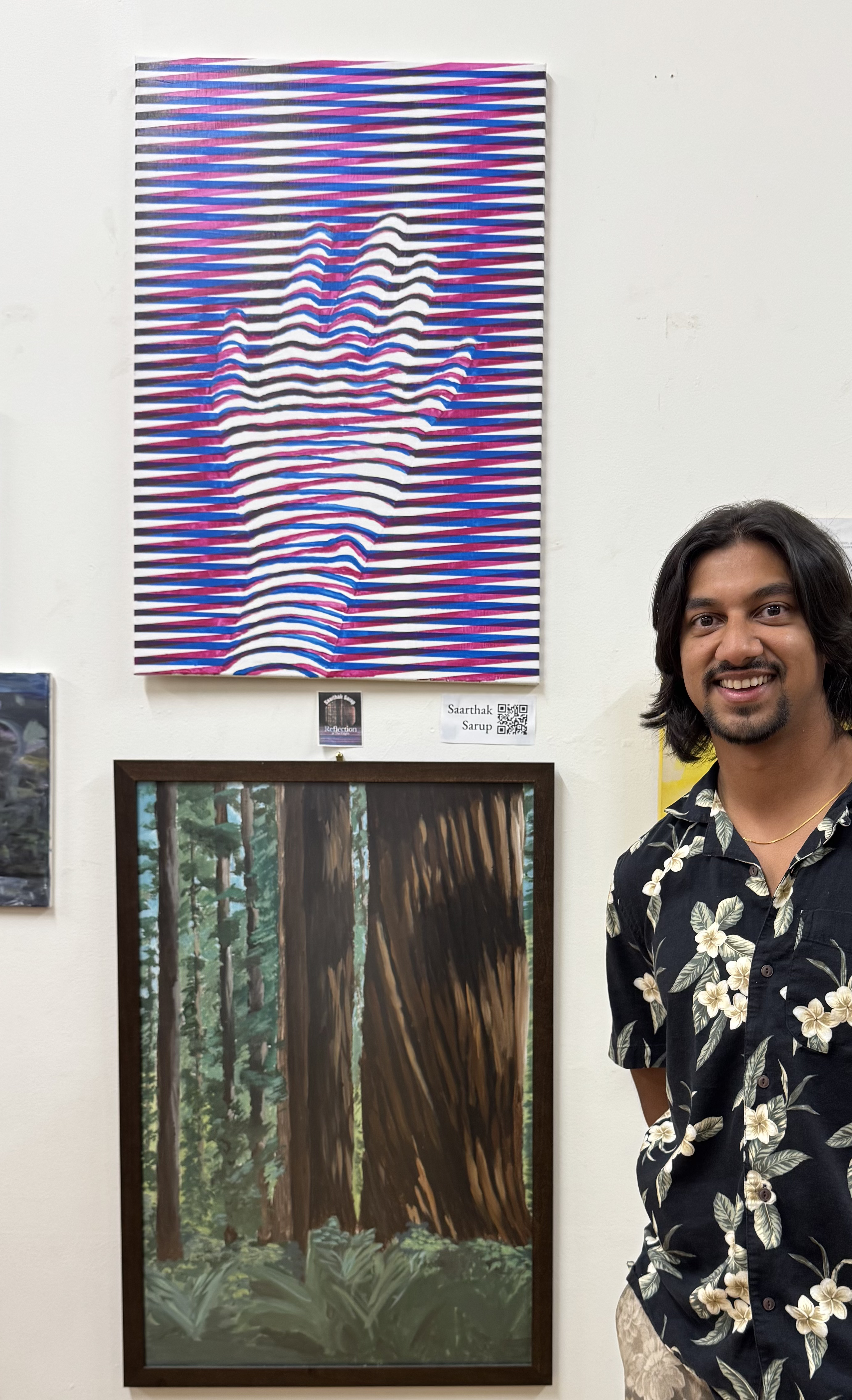
The piece uses phase: the phenomenon where two nearly identical repeating systems, superimposed with a slight offset, produce interference patterns that neither could produce alone. In music, two tones at slightly different frequencies produce beats. In two dimensions, two line fields at slightly different spacings produce Moiré-like distortions that ripple across the entire composition, not just locally where the two systems interact but globally, everywhere you look. This is not a metaphor for two people with different filters so much as a formal analog to it. It’s the same structure, instantiated in paint.
The two line systems are cyan and magenta, which are not arbitrary. They are subtractive primaries, the colors of optical mixing, designed to combine not on the canvas but in the eye of whoever is looking. The color relationship is unresolved in the painting itself. It completes differently in each viewer.
At the center of the composition is a hand, reaching. First, it was traced from a shadow. It was a friend’s hand raised up to a light, projected flat onto a two-dimensional canvas. Next, the two line systems overlayed. At the hand, where the two line systems bend and crowd around the form, the lines were painted freehand. Everywhere else they were taped to be clean, controlled, and precise. It was unintentional that at the emotional core the system breaks down into something imperfect and human.
And finally what’s left is the unpainted hand. The hand is the negative space implied by the way the lines around it behave. The hand exists only as a disturbance in the surrounding fields, inferred from what it displaces rather than seen directly. This shares its structure with how empathy actually works: you never have access to another’s pain itself, only to the signals it produces in the world around them. You construct their experience from its edges.
Without the hand, the interference pattern between the two systems would be regular: a predictable, even ripple across the whole canvas. The hand distorts that. It bends not just each line system individually but the relationship between them, the Moiré itself, out of its expected shape. What you are seeing in the center of the composition is not just two systems responding to an absent form. It is the distortion of their relationship, caused by something neither of them contains. That distortion, the bent relationship between two people both responding to the same pain, is what it feels like from the inside to be close to someone who is suffering.
And the closer the relationship, the more precisely you can feel the contour of what you cannot reach. The resonance is just as incomplete as it would be with a stranger. But now the incompleteness is intolerable rather than simply present. You feel more of their pain and are more undone by how much of it remains theirs alone.
But consider what it would mean to close that gap completely — to fully absorb another's pain, to take it so entirely into yourself that no remainder persisted. You would cease to be a separate person standing next to them. There would be no one left to witness. The gap is not incidental to being present for someone in pain. It is what makes presence possible at all. You remain distinct, and they can turn toward you, precisely because their experience never fully became yours.
In Remainder, cyan and magenta run alongside each other across the whole canvas, deformed by the same hand, never becoming the same color.